These special people, through their dedication and unwavering determination, were instrumental in the creation and success of the JGDC.
Randi Yudenfriend Glaser
Stanley Michelman
Lois Neufeld
Lawrence R. Shapiro, MD
The JGDC in Communities and the Media
Educating the Community About Jewish Genetic Diseases

By Erin Ben-Moche
Jewish Journal, March 11, 2020
…”the information gathered from testing is too complicated for a layman to break down, and if read incorrectly can result in a misdiagnosis.” -Shari Ungerleider, JGDC

Why the Holiday of Sukkot Offers a Reminder for Genetic Screening
By Karen Grinzaid, Jewish Journal, September 25, 2018
With the yearly Jewish harvest holiday of Sukkot underway (September 23-30), many in the Jewish community have focused their efforts on building a sukkah , a dwelling, often in one’s backyard, that essentially serves as places to eat and—for people who choose—to sleep. Continue story
The JGDC Exhibits at Medical Conferences
 The JGDC teamed up with Jscreen at the American College of Obstetricians and Gynecologists (ACOG) annual conference in Austin, TX. At this event, we shared our information about the importance of carrier screening with OB/GYN’s from around the world. We emphasized the importance of educating patients prior to pregnancy, as well as, explained the new expanded carrier screening panels that are targeted for everyone not only certain ethnic groups.

The JGDC continues to exhibit annually at the New Jersey American Academy of Pediatrics Annual Conference (NJAAP) in Somerset, NJ and Residence Day in Edison, NJ. During this time we create the opportunity to meet and speak with many pediatricians who practice throughout New Jersey to share with them the importance of carrier screening. This group of doctors has the opportunity to speak with young adults before they go off to college and share this information with them. They also speak with parents and can share the importance of being screened and the need to update screening with each pregnancy.
“Why to test for Tay-Sachs” an article from The Jewish Standard
Ashkenazi Jews, at high risk for fatal childhood disease, have tools to avoid it
Published by The Jewish Standard
Link to full article: http://jewishstandard.timesofisrael.com/why-to-test-for-tay-sachs/
BY ABIGAIL KLEIN LEICHMAN
September is Tay-Sachs Awareness Month, an opportunity to learn about this fatal genetic disease and the simple genetic screening test people can take before they start a family.
The statistics are sobering.
One in 30 Ashkenazi Jews, and one in 300 people in the general population, is a carrier of Tay-Sachs, a fatal chromosomal disorder that causes progressive neurological damage. Babies born with Tay-Sachs rarely live beyond the age of four.
However, thanks to more accurate and widespread screening in the Jewish community, the incidence of babies born with Tay-Sachs has dropped by more than 90 percent among Jews since the 1970s.
“The genetic screening offered today is fast, easy, and comprehensive,” Karen Grinzaid of JScreen said. JScreen is a nonprofit project that offers home kits requiring only a saliva sample to reveal if someone is a carrier of Tay-Sachs or about 200 other genetic diseases.
JScreen estimates that one in three Jews is a carrier for a genetic disease. “When a couple is unaware of diseases they carry, the results can be devastating,” said Hillary
Kener, who does national outreach for JScreen. “Any young adult planning to start a family or grow their family in the future should get screened. The history of Tay-Sachs in this country shows how genetic testing can positively influence people’s lives and the health of their children.”
Shari Ungerleider of Wayne needs no reminder.
As project coordinator at the Jewish Genetic Disease Consortium and a board member of the National Tay-Sachs and Allied Diseases Association, she is devoted to encouraging would-be parents to get tested in order to avoid the heartbreak of giving birth to a terminally ill child. She and her husband, Jeff, endured this devastating scenario firsthand. Their firstborn, Evan, was diagnosed with Tay-Sachs at 13 months. He died in 1998 at the age of 4ó.
“To honor Evan, I decided to turn our tragedy into something positive so that other families would be spared the suffering that we experienced,” Ms. Ungerleider said. “Having a child with a rare disease made me realize the importance of raising awareness about Tay-Sachs and the relate genetic diseases.”
She was, in fact, tested for Tay-Sachs during her pregnancy with Evan and was told erroneously, it turned out — that the results were negative. (If one parent tests negative, there is no need to test the other because a child can have Tay-Sachs only if both parents are carriers. Each child of two carrier parents has a 25 percent risk of having the conditions.)
Therefore, when the Ungerleiders took Evan for a pediatric checkup at 10 months and expressed concern that he wasn’t developing at the same pace as other babies his age, the doctor didn’t immediately suspect that he had Tay-Sachs. All the specialists they consulted over the next three months asked if Ms. Ungerleider had been tested for Tay-Sachs. When she said she had, they saw no choice but to subject the baby to myriad diagnostic procedures to find some other explanation for his rapid developmental regression, which by now was causing feeding difficulties. “Finally, at 13 months, a pediatric ophthalmologist discovered a cherry-red spot in Evan’s eye, which is indicative of Tay-Sachs,” Ms. Ungerleider said. “I called my OB/GYN to tell him they found this cherry-red spot. He called me back and said he had misread my Tay-Sachs test. I was a carrier. It was the missing piece to the puzzle, and the diagnosis was confirmed via blood work.”

The Ungerleiders channeled their grief into raising money for Tay-Sachs research and telling the story of their tragedy as a cautionary tale.
“In our work, we promote not just testing, but accurate testing,” Ms. Ungerleider said. “We also promote preconception carrier screening, because once you’re pregnant and find out the baby has a genetic disease, you have only two choices: to terminate or to have the child. Now there are so many options available to have healthy children if you find out you’re a carrier before conception.”
Among several options is preimplantation genetic diagnosis — PGD — to identify genetic defects in an embryo conceived through in-vitro fertilization. Another option is using donor sperm or eggs. Adoption, of course, is another alternative.
Ms. Ungerleider eventually gave birth to three healthy children, who are 14, 17, and 20 years old. The Ungerleiders formed the Jewish Genetic Disease Consortium in 2005. Its goal is to educate physicians, rabbis, and the general community on the availability and importance of carrier screening. The group recommends that rabbis raise the issue during premarital counseling sessions.
“When JScreen started, we saw that they were offering a lot of the same educational programs and doing a good job of reaching people all over the country who might not have access to places to do screenings, so we began working together,” Ms. Ungerleider said. “Carrier screening has changed so much over years, and JScreen makes it reasonable and offers counseling. Since not everybody really knows what their ethnic background is, it’s essential to have an expanded panel,” she added.
The JScreen “spit kit” can be ordered online at jscreen.org. The saliva sample is collected at home and mailed to the lab for DNA testing. The kit costs $149 with private insurance; people without private insurance may qualify for financial assistance.
If the test reveals an elevated risk for passing along any of more than 200 genetic disorders, certified genetic counselors associated with JScreen will contact the person to talk about results, options, and resources.
According to JScreen, a nonprofit public-health initiative based at Emory University School of Medicine in Atlanta, 80 percent of babies with genetic diseases are born to parents with no known family history of that disease.
JScreen reports that it detects nearly two times as many carriers of genetic diseases in people of Ashkenazi Jewish descent as in the general population. Like Ashkenazi Jews, French Canadians and Louisiana Cajuns are considered to be at high risk for carrying Tay-Sachs disease.
© 2017 THE JEWISH STANDARD, ALL RIGHTS RESERVED
How rare sheep from biblical times may help kids with a deadly genetic disease

by Eric Velasco
When sheep breeders Fred and Joan Horak noticed some abnormalities in some of their sheep, they decided to figure out what was wrong. Their quest to discover why the lambs died ultimately helped advance research into Tay-Sachs, a genetic disease that affects humans as well as animals. Read story
“Jewish” Genetic Diseases and non-Jewish carriers
Non-Jews Hit by ‘Jewish’ Diseases Fall Through the Cracks of Genetic Screening
Researchers Push for More Universal Testing
By Gabrielle Birkner
The Jewish Daily Forward
August 11, 2013
For three days in April, about 70 families whose lives have been upended by Tay-Sachs disease gathered in San Diego for the annual National Tay-Sachs and Allied Diseases conference. The event — which attracted families caring for children with Tay-Sachs, as well as those who have lost loved ones to the degenerative disease that claims most of its victims by age 4 — included forums on symptom management and new research frontiers. There were also support group sessions and a candle-lighting ceremony honoring those who had died.
Tay-Sachs is probably the best known “Jewish” disease. As many as one in 25 Ashkenazi Jews is a carrier of the defective recessive gene. Yet, among the conference attendees, who came from as far away as Poland and Guatemala, only a handful were Jewish. “When I speak with newly diagnosed families, they often say, ‘But we’re not Jewish,’” said Kimberly Kubilus, NTSAD’s director of family services. read more
Jewish Daily Forward story: Genetic Testing for Sephardic Jews Faces Reluctant Community
Genetic Testing For Sephardic Jews Faces Reluctant Community
Screening for Muscle Ailment Provides Alternate Model
By Anne Cohen
The Jewish Daily Forward
August 11, 2013
When Jennifer was 26, people started asking her why she was limping. An exercise enthusiast, she brushed aside the question. Then she noticed she couldn’t run laps in her kickboxing class. No problem, she thought — running wasn’t her thing. Next, she started falling behind some older women in Pilates class. By that time, she and her husband were planning on starting a family. Just to be safe, she decided to see a doctor.
Jennifer, a psychiatrist who asked that only her first name be published because she does not want her personal story revealed to patients, first saw a sports physician. He referred her to a podiatrist, who advocated surgery. Unwilling, she went to a physical therapist.
“You definitely have weakness,” she remembers him saying about her muscles. Though he didn’t think it was anything serious (“not genetic or progressive”), he sent her to a neurologist at UCLA. The medical fellow who examined her was a Persian Jew. He knew exactly what was wrong — it was genetic, and it was definitely progressive. read more
JGDC launches Rabbi Education Program
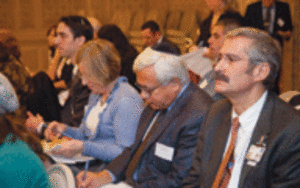
On October 21st, 2010 the JGDC launched “Couples Aware”, a Rabbi Education Program presented in partnership with the NY Board of Rabbi’s (NYBR) and the UJA.
‘Couples Aware’ was created to better educate rabbis so that they may in turn inform their constituents, particularly young couples in pre-marital counseling, about the risks of Jewish Genetic Diseases and to encourage them to seek complete genetic screening prior to pregnancy.
The JGDC Rabbi Education Program consists of a physician or genetic counselor led a 45-minute seminar, a personal story from an individual with a family member afflicted with a Jewish Genetic Disease, and a rabbi led discussion and Q & A session.
Speakers at the Park Avenue Synagogue launch included: Rabbi Elliot Cosgrove, Chair of this programs’ Rabbinic Advisory Committee and leader of the Park Avenue Synagogue, Rabbi Joseph Potasnik, Executive Vice President NYBR, John Ruskay, Executive Vice President and CEO of UJA-Federation NY, Dr. Harry Ostrer, Professor and Division Director of Human Genetics Departments of Pediatrics and Pathology, NYU Langone Medical Center, and Randy Yudenfriend-Glaser, Chair of the JGDC
In attendance at the event were rabbis of all Jewish faiths from the NY, CT and NJ areas. The launch included a training session and Q&A moderated by Dr. Susan Klugman, Director of the Division of Reproductive Genetics at Montefiore Medical Center) and Rabbi Deborah Bravo of Temple Emanu-El in Edison, New Jersey.
Rabbi Education Program: In the News
The Jewish Week (NY): “Training Rabbis To Promote Screening”
On NBC’s New York Nightly News with Chuck Scarborough, Rabbi Joe Patasnik (Executive Director, New York Board of Rabbis) and Randy Yudenfriend Glaser (Chair, JGDC) discuss the JGDC Rabbi Education Program
Dramatic progress in in-vitro detection spurs new push for Ashkenazi Jews to do genetic disease test (JTA)
By Hillel Kuttler · August 24, 2011
WASHINGTON (JTA) — Susan and Brad Stillman grew concerned following their son Benjamin’s birth in September 1998. He was fussy and congested, had difficulty breastfeeding and didn’t take to the bottle.
The parents brought him to the pediatrician and then to a hospital pediatric care unit near their home in Rockville, Md., a suburb of Washington.
Benjamin soon was diagnosed with Riley-Day syndrome, now called familial dysautonomia, a genetic disease of the autonomic nervous system that disproportionately strikes Ashkenazi Jews.
When the Stillmans got married in 1995, they were tested for Tay-Sachs disease, the only genetic disease prevalent among Ashkenazim for which screening was available, and neither parent was found to be a carrier or to have the disease.
“Ignorance was bliss,” Susan Stillman said. “We had no idea we were carriers for FD.”
Today, tests are available for 19 chronic conditions that are known as Jewish genetic diseases, including familial dysautonomia. Testing capabilities have risen dramatically: Just one year ago, individuals could be tested for 16 conditions; in 2009, the number was 11. Among those conditions, in addition to FD and Tay-Sachs, are cystic fibrosis, Gaucher disease, Canavan disease and Niemann-Pick disease.
Organizations dealing with Jewish genetic diseases are intensifying their efforts to educate Ashkenazim of childbearing age about the need to be screened for all 19 conditions with a single blood test, and to update tests that have already been conducted. The experts view this as a serious communal health issue, with one in five Ashkenazim estimated to be a carrier of at least one of the 11 diseases that could be tested for in 2009.
A study by New York University’s Mount Sinai School of Medicine in Manhattan found that significant numbers of New York-area Ashkenazim —one in every 3.3 — are carriers of at least one of the 16 diseases tested for last year.
A carrier rate of one in 100 for an individual disease would be “of concern,” said Dr. Adele Schneider, director of clinical genetics at Philadelphia’s Victor Centers for Jewish Genetic Diseases.
As with any genetic disease, when both parents are carriers, each of their children will have a 25-percent likelihood of being affected; the more diseases for which each parent is a carrier, the greater the odds of the children being affected.
“If you and your spouse find out that you’re carriers, you may not want to take that one- in-four chance,” said Karen Litwack, director of the Chicago Center for Jewish Genetic Disorders. “It’s a terrible ordeal for parents to go through. From a Jewish community standpoint, there’s a general consensus that education and outreach will, hopefully, prevent this kind of thing from happening.”
Experts in Jewish genetic diseases are seeking to promote awareness of the potential problems, because screening before a pregnancy can offer options for preventing or dramatically reducing the chance of a child being born with a disease. The four main alternative options are utilizing a sperm donor; utilizing an egg donor; pre-implantation genetic diagnosis (in-vitro fertilization of the mother’s egg, analysis of the embryo, and implantation only if the embryo is healthy); and even aborting a fetus affected by both parents’ disease-carrying genes.
“Screening is protecting future generations,” said Randy Yudenfriend-Glaser, who chairs the New York-based Jewish Genetic Disease Consortium. She is the mother of two adult children with mucolipidosis type IV, one of the known Jewish genetic diseases.
“When you’re young and getting married, you don’t want to know about it because it’s scary,” she said. “But you should want to know about it.”
Experts also emphasize the need for each carrier to be screened prior to each pregnancy to account for additions to the screening panel in the interim.
Several organizations are expanding their outreach to rabbis and Jewish communal leaders to enlist their help in persuading prospective parents to get tested. Even doctors don’t push sufficiently for testing, representatives of these groups say.
The Victor Centers’ survey in April of 100 Atlanta-area obstetricians, gynecologists, primary care physicians and pediatricians found that only 51 percent routinely recommend preconception screening, and just 34 percent recommend updated screenings between pregnancies. Not a single respondent reported recommending screening for more than six of the 19 known diseases.
The findings were “stark” and “very worrisome,” said the Victor Centers’ national project director, Debby Hirshman.
The agency’s Atlanta branch has secured the agreement of area rabbis to distribute fact sheets to the 17,000 congregants expected to attend High Holiday services next month.
The Jewish Genetic Disease Consortium, with the support of the New York Board of Rabbis, last September inaugurated a clergy awareness program.
Several rabbis have taken the effort to spearhead educational efforts into their own hands. Rabbi Peter Kasdan, a Reform rabbi from New Jersey who has moved to Florida in retirement, has made it a requirement that couples undergo testing before he performs their weddings. Rabbi Larry Sernovitz of Philadelphia’s Old York Road Temple-Beth Am, whose son was born with familial dysautonomia, successfully lobbied the Union for Reform Judaism to host a session on Jewish genetic diseases at its upcoming convention in Washington. Rabbi Joseph Eckstein, who lives in New York, lost four children to Tay-Sachs disease, and in the 1980s he founded Dor Yeshorim, a Brooklyn-based organization that promotes screening in Orthodox communities.
In August, the Victor Centers rolled out an iPhone and iPad application it has developed with information on Jewish genetic diseases.
The outreach efforts mean a lot to Stillman. Last week, she spoke about her situation during a panel discussion at the 31st IAJGS International Conference on Jewish Genealogy in Washington. Stillman described her son as a sweet, loving child. Benjamin, who is entering the eighth grade, plays piano and plans to celebrate his bar mitzvah in September. But he’ll always have to eat through a feeding tube and to receive daily medication.
Stillman isn’t sure if Benjamin can live independently, marry or have children.
“I don’t know how long my child will live. I can’t look too far down the road — only half the kids live to age 30,” she said of those diagnosed with familial dysautonomia. Her presentation at the genealogy conference, Stillman said, had one goal: raising awareness.
“It can happen to you,” she said. “I am a regular person. It happened to me.”